AI in Coding Interviews: Company Policies and How to Prepare
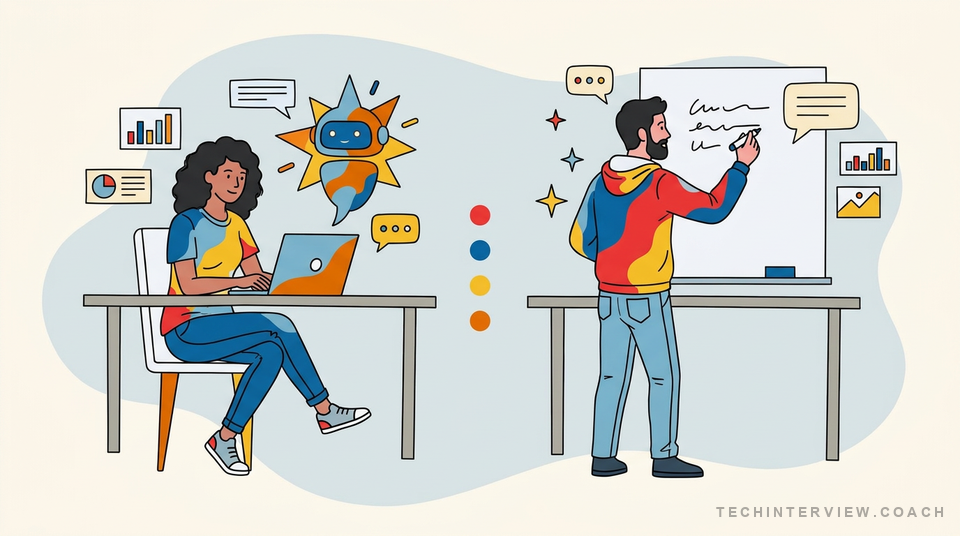
Two engineers with the same experience can now sit coding interviews with opposite rules in the same month. One is handed a small codebase and a chat assistant and is expected to use it. The other is told that opening any AI tool ends the process. The rules on AI in coding interviews depend on the company, sometimes on the team, and in at least two large companies the public reports contradict each other.
That makes preparation awkward. Practising only without an assistant leaves you slow and clumsy in a round built around one. Practising only with one leaves you exposed at a whiteboard. This guide sets out what each company has actually said or been reported to do, as of November 2026, with the source for each line, and then a way to prepare for both formats without doubling your hours.
The split in 2026
The clearest number comes from Karat, a company that runs technical interviews for employers. In an article published in January 2026 it reported a survey of 400 engineering leaders in the United States, India and China: 62% of organizations still prohibited AI use in technical interviews. The same article gave 38% of US companies allowing AI in live technical interviews, against 68% in China. It is a vendor's survey and the picture has moved since, but it sets the baseline. Most interviews you sit this year will forbid AI.
The minority that allow it is growing from two directions. Some companies decided that a puzzle a model solves in seconds no longer measures anything, and rebuilt the round around a larger task with an assistant in the loop. Others kept the classic round and moved it somewhere an assistant cannot follow, which is one reason in-person interviews are back.
A third thing confuses the picture. "AI in the interview" is also used for interviews conducted by an AI, which is a different subject, covered in the guide to AI interviewers. This post is about the tools you are or are not allowed to use.
Company policies with their sources
Read the table with two cautions. A press report describes what a journalist saw at a point in time, usually an internal document, and companies rarely confirm the detail. A company statement is firmer but tends to be general. Neither tells you what your own loop contains.
| Company | Position as of November 2026 | Source type |
|---|---|---|
| Meta | One AI-assisted coding round in the onsite; the other coding round has no AI | Press report, candidate accounts |
| Varies: Gemini allowed in a pilot round for some US teams; otherwise no AI | Press report | |
| Amazon | Forbidden in interviews unless explicitly permitted; reports conflict on assessments | Press report, company statement |
| Canva | Expected in technical interviews for backend, frontend and machine learning roles | Company statement |
| Anthropic | Forbidden in live interviews and take-homes unless told otherwise | Company statement |
| Datadog | Forbidden in live coding unless told otherwise; some roles have an AI coding interview | Company statement |
| Cognition | Not allowed | Press report |
The detail behind each row matters more than the label.
Meta. In July 2025, 404 Media reported an internal message saying Meta was developing a coding interview in which candidates have access to an AI assistant, and TechRadar quoted a Meta spokesperson saying the company was testing how to provide these tools to applicants. Meta's public prep material does not describe the round. What candidates have reported since October 2025 is a 60-minute round in the onsite that replaces one of the two coding interviews, with the other unchanged. Prep sites disagree on whether it is still a pilot. The format is covered in the guide to Meta's AI-assisted coding interview.
Google. Two reports pull in different directions. In June 2025 Sundar Pichai said on the Lex Fridman podcast that Google would bring back at least one round of in-person interviews to make sure candidates have the fundamentals, as Entrepreneur reported that August. Then in May 2026 Entrepreneur, citing an internal document seen by Business Insider, reported a pilot starting in the second half of 2026: candidates for early and mid-career software engineering roles on selected US teams may use an approved assistant, which a spokesperson confirmed is Gemini, in a code comprehension round. Both can be true at once, and probably are: a classic round in person and an assisted round in a pilot. No source read for this guide says the pilot covers senior levels or teams outside the United States. If you are interviewing at Google, assume no AI and ask.
Amazon. In March 2025 ITPro, citing internal guidelines obtained by Business Insider, reported that Amazon asks candidates not to use generative AI tools during interviews unless explicitly permitted, and that breaking the rule may mean disqualification. Amazon's own article on AI in its hiring, dated January 2026, says its technical assessments let candidates work with an interactive AI assistant on a real coding platform. So the live interview and the assessment may follow different rules, and the "unless explicitly permitted" clause is doing real work. Amazon has not published a single candidate-facing rule that settles it. Treat every Amazon stage as no AI unless the instructions for that stage say otherwise in writing.
Canva. The firmest statement on the permissive side. On its engineering blog in June 2025, Canva wrote that it now expects backend, machine learning and frontend candidates to use AI tools in technical interviews, naming Copilot, Cursor and Claude, and that an AI-assisted coding interview replaced its computer science fundamentals screen for backend and frontend roles. Candidates are told in advance.
Anthropic. Its candidate guidance page, last updated in July 2025, allows Claude for refining a resume you drafted yourself and for preparation, and says live interviews and take-home assessments are done without AI assistance unless the company indicates otherwise. Some unsourced trackers list Anthropic as AI-permitted in coding rounds. The company's own page says the opposite as a default.
Datadog. Its candidate guidelines, updated in May 2026, say not to use AI tools in live coding interviews or technical assessments unless explicitly told otherwise, that some engineering roles include an AI-assisted coding interview you will be told about in advance, and that misuse or failure to disclose can lead to disqualification.
Cognition. In a May 2026 Moneywise article republished by Yahoo Finance, the company's head of people and operations compared a no-AI interview to a maths test without a calculator, and the same article reported that Cognition does not allow AI in its own interviews.
Several lists circulating online assign a policy to dozens more companies without naming a source for any of them. Those companies are left out here. For a company not in this table, the recruiter is the only reliable source.
How AI-assisted rounds are graded
The published criteria are consistent across the companies that have said anything.
Canva's post lists what its interviewers look for: whether you know when and how to use AI, how you break down ambiguous requirements, whether your technical decisions are sound, whether you find and fix problems in generated code, and whether the result meets production standards. The Google pilot, per the Entrepreneur report, assesses "AI fluency", described as prompt engineering, output validation and debugging. For Meta, prep sites that collect candidate reports list problem solving, code quality, verification and communication.
None of these lists rewards the model's output. They reward what you do around it:
- Decomposition. You turn a vague task into pieces small enough to delegate or write, and you say the plan aloud before you prompt.
- Scoped prompts. You ask for one function with its constraints, not for the solution.
- Verification. You read what comes back, run it, and test the edge cases. Canva reports that candidates with little AI experience struggled because they could not judge weak suggestions, not because they could not code.
- Ownership. You can explain every line. Canva's phrase is that engineers take full ownership of any code they produce.
The tasks are bigger than a classic problem for that reason. Canva gives an example of the change: where it once asked for Conway's Game of Life, it now asks for a control system for aircraft takeoffs and landings at a busy airport. An hour with a task like that and no plan is how people fail these rounds, with or without a model.
How no-AI rounds have changed
The rounds that forbid AI have not stood still either. Three changes show up in the reporting.
More of them are in a room. Besides Google, the Wall Street Journal has reported Cisco and McKinsey among employers asking for face-to-face stages. A room removes the assistant and also the editor, the autocomplete and the ability to run code.
Remote ones come with checks. A September 2026 Wall Street Journal report, republished by Allwork.Space, describes employers asking candidates to drop virtual backgrounds, pan the camera around the room, share the screen or wave a hand in front of the face. Amazon's guidance to interviewers, per the ITPro report, lists typing while answering and reading instead of responding naturally as signs to watch for. Expect to be asked, and do not take it personally.
Reasoning aloud carries more weight. An interviewer who cannot be sure the code is yours leans on what cannot be faked: why this data structure, what happens at the boundary, what you would change for ten times the input. Candidates who used to pass by producing a correct solution quietly now find the follow-up questions are the interview.
Preparing for both in one plan
The two formats share more than they seem to. Both grade your reasoning and your checking. Only the typing differs. A plan that covers both, at about an hour a day:
- Keep the classic base. Three or four timed problems a week with no assistant, no autocomplete and no running the code until you have traced it by hand. If any target company interviews in person, do one of them on paper or a whiteboard.
- Add one assisted session a week. Take a small unfamiliar repository, or have a model generate a multi-file project with a planted bug and failing tests. Give yourself an hour: read first, fix the bug, add a feature with a chat assistant, then harden it. Type or paste every change yourself.
- Narrate in both. Record yourself. The classic failure in an assisted round is going silent while reading the model's answer. In a no-AI round, the usual one is going silent while stuck.
- Review differently. After a classic session, note where you were slow. After an assisted one, count the lines you accepted without understanding. That count should reach zero.
- Rehearse with a person twice. You cannot interrupt yourself with "why that structure". A colleague can, and so can someone who has run these interviews: a coding interview coach can run one session in each format so you feel the difference before the real loop.
Weight the plan by your target list. If every company on it forbids AI, one assisted session a fortnight is enough to stay current. If Meta or Canva is on it, make it two a week.
The rest of the mechanics of practising with another person are in the mock interviews guide.
The line between allowed and cheating
The line is drawn by the instructions for your stage, and nothing else. Using an assistant where it is provided or permitted is the task. Using one where it is forbidden is misrepresentation, and the companies that publish a rule also publish the penalty: Amazon's reported guidelines and Datadog's public ones both name disqualification.
Three grey areas deserve an explicit answer.
- Preparation. Using a model to explain a concept, generate practice problems or critique a recorded answer is allowed under every policy read for this guide. Anthropic and Datadog both say so directly.
- Take-homes. Policies vary most here. Datadog allows AI for research and structure and expects the submission to reflect your own conclusions, defended live. Anthropic says to complete them without Claude unless told otherwise. If the instructions are silent, ask, and say in your submission what you used.
- Hidden assistants in live rounds. Tools that listen to the interviewer and feed you answers are the reason for the camera checks and the return to offices. Apart from the ethics, an interviewer who suspects one stops scoring the code and starts probing, and a candidate reading from a second screen does badly under probing.
When unsure, disclose. "I used a model to draft the test scaffolding and wrote the logic myself" costs nothing where AI is allowed and protects you where the rule was ambiguous.
What to ask the recruiter
Send these in one message as soon as the loop is scheduled. Recruiters answer them routinely.
- Is any round in my loop AI-assisted, and which one?
- For the other rounds, are AI tools, autocomplete or running code allowed?
- Which editor or platform is used, and can I get a practice environment?
- If an assistant is provided, which models, and can it edit files or only chat?
- Is any round in person? If so, is coding on a whiteboard or a laptop?
- For a take-home, what is the policy on AI tools?
Keep the reply. If an interviewer's instructions on the day differ from it, follow the interviewer and mention the difference to the recruiter afterwards.
Where coaching fits
A coach helps most with the part you cannot produce alone: a person watching, interrupting and asking why, in whichever format your loop uses. Nine of the 40 coaches on techinterview.coach list coding interviews as of November 2026; you can compare them on the coding interview coaches page and say in your booking note whether you want a classic round, an assisted one, or one of each. For the reasoning-aloud half on your own, the practice interview has a coding talk-through round with an AI interviewer and a written recap. It is free; sign in to start.
Related guides
- Meta's AI-assisted coding interview: the environment, task shape and grading of the best-documented assisted round.
- In-person interviews are back: what changes when the no-AI round moves to a whiteboard.
- AI interviewers: the other meaning of AI in interviews, where the interviewer is the model.
- Mock interviews guide: how to set up practice with a second person.
- Google software engineer interview: the loop the Gemini pilot sits inside.