AI Interviewers Are Here: How to Prepare for Them
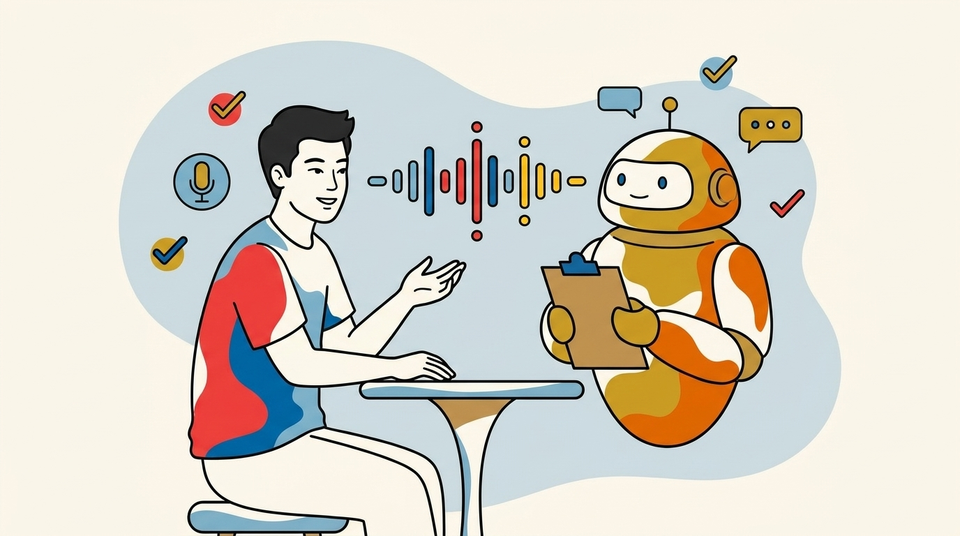
A growing share of first-round interviews now happen with no human on the other end: an AI voice agent asks the questions, follows up on your answers, and produces a scored assessment before a person ever reads your name. Whatever you think of the trend, it's operational reality at high-volume employers, and it rewards slightly different preparation than a human screen. Having built AI interviewing technology ourselves, here's an honest guide from both sides of the microphone.
What an AI interview actually is
Typically: a scheduled call or browser session where a voice agent runs a structured screen: behavioural questions, role knowledge, sometimes talking through a technical scenario. Under the hood it transcribes you in real time, asks adaptive follow-ups, and afterwards scores the transcript against a rubric (communication, relevant experience, depth, role fit), producing a summary a recruiter reviews.
Three properties follow that shape everything below: it's transcript-first (what you say is nearly all of the signal), rubric-driven (consistent criteria, no charm offsets), and follow-up-capable but literal (it probes your claims, but won't rescue a rambling answer the way a kind human might).
What changes for you
- Structure pays even more. A rubric-scoring model is exactly the audience STAR was made for: clear Situation, your Task, first-person Actions, quantified Result land as clean, extractable evidence. Rambling answers that a human would untangle simply score as noise.
- Say the substance out loud. There's no interviewer inferring competence from your vibe. If you led the migration, say "I led", name the stack, give the number. The transcript is the interview.
- Completeness beats rapport. Small talk, humour and mirroring (the skills that warm up a human screen) mostly don't transfer. Redirect that energy into answering the question that was actually asked, fully, then stopping.
- Expect literal follow-ups. Claims invite probes: say "I improved reliability" and the next question is likely "how, specifically?" This punishes padded stories and rewards the story bank you should have anyway.
- Logistics are part of the score. Quiet room, decent microphone, wired connection. A human forgives a barking dog; a transcription pipeline turns it into missing words.
Practical technique on the call
- Treat it as fully real: same clothes, posture and energy as a human interview. It leaks into your voice, and voice is the medium.
- Answer in 60–120 second blocks with a clear ending. Trailing off invites either an awkward silence or a cut-off.
- It's fine to pause. "Let me think about that for a moment" transcribes perfectly well.
- If you misspoke, correct explicitly: "Actually, let me restate that…" reads cleanly in a transcript.
- Don't try to game it with keyword-stuffing. Adaptive follow-ups collapse hollow claims fast, and a recruiter reads the summary; theatre that survives the AI still has to survive the human.
The fairness question, honestly
AI screens are consistent in ways humans aren't: same questions, same rubric, no Friday-afternoon effect. They also inherit real concerns: accent and disfluency robustness, opaque criteria, and the discomfort of being scored by a machine. Serious vendors mitigate (human review of scores, appeal paths, audited rubrics); as a candidate, your protections are preparation, explicit claims, and asking the recruiter what happens downstream of the AI's assessment, a fair question that good employers answer readily.
The upside nobody mentions
The same technology with the stakes removed is the best rehearsal tool ever built: unlimited, judgment-free reps with structured feedback, exactly the deliberate practice a mock interview cadence needs, on demand. Candidates who practise against AI and calibrate with a human coach get the compounding of both: volume from the machine, judgment from the person who has sat on real panels.
Want to be ready for both kinds of interviewer? Get matched with a coach: human judgment, real-loop calibration, and practice that transfers whether the next voice you hear is a person or a model.